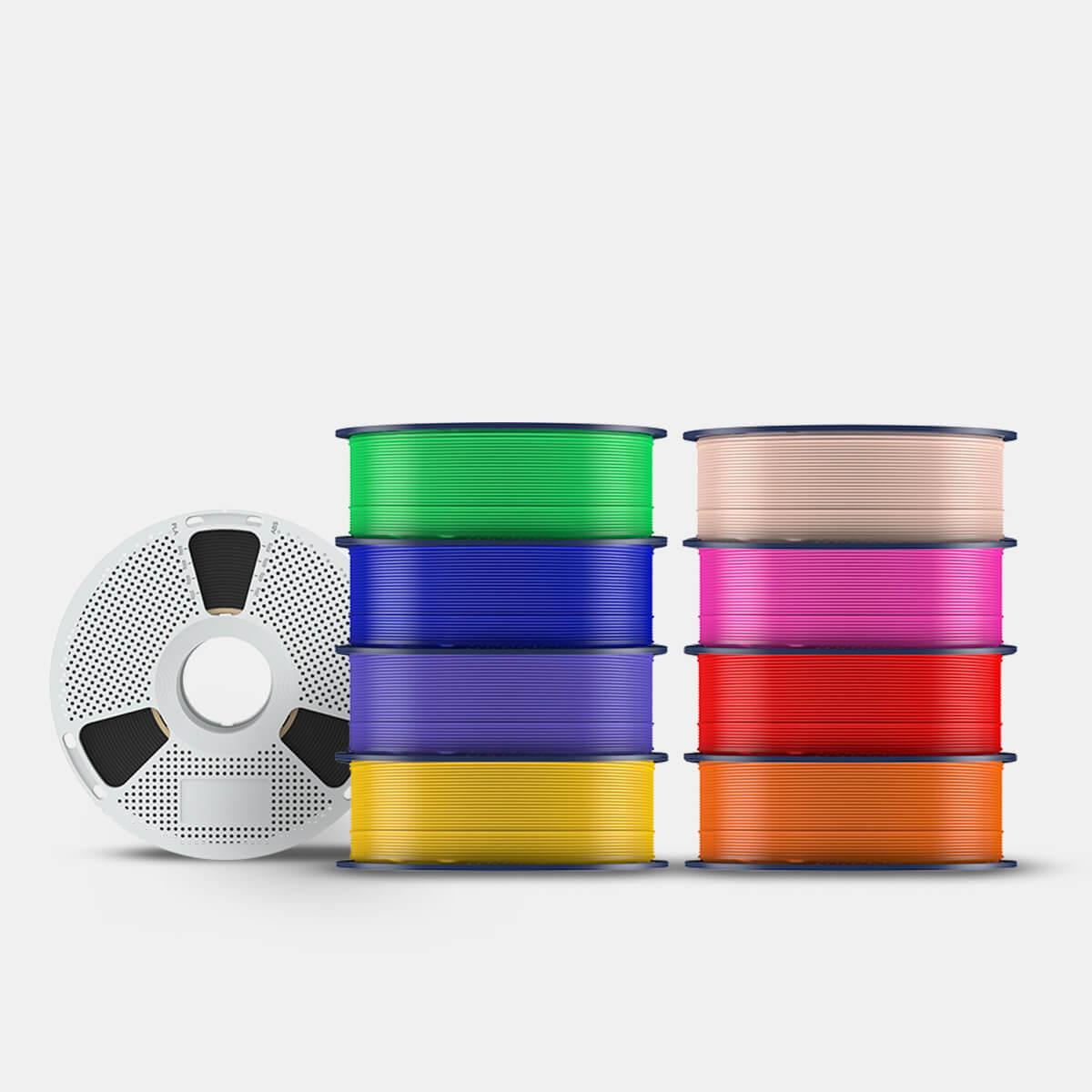
Choosing a 3D printer filament material based on heat resistance can prevent deformation, dimensional instability, and premature part failure. For low-temperature applications, PLA filament remains practical and easy to print, but it is not the strongest choice for heat exposure. ABS and ASA offer higher thermal performance, while SUNLU ASA stands out for applications that also demand outdoor weather and UV resistance. For business buyers, the right choice depends on both operating temperature and the environment surrounding the printed part.
Why Heat Resistance Matters in 3D Filament Material Selection
Heat resistance is not simply about whether a filament can survive a hot environment. A printed component may soften, deform, or lose dimensional accuracy when exposed to sustained heat, even if it does not visibly melt. Therefore, buyers should examine technical indicators such as heat deflection temperature (HDT) and Vicat softening temperature when selecting a 3D printer filament material.
These values help provide a more useful basis for comparing materials. They should not, however, be treated as a universal maximum service temperature. Actual performance depends on part geometry, load, print orientation, exposure time, and the surrounding environment.
PLA Filament: Efficient for General-Purpose Production
PLA filament is widely used because it combines straightforward printing with good dimensional stability and attractive surface quality. It can be a sensible choice for prototypes, visual models, fixtures, and applications where operating temperatures remain relatively moderate.
SUNLU’s PLA Matte specification lists a heat deflection temperature of 55±5°C and a Vicat softening temperature of 54°C. Its recommended nozzle temperature is 205–215°C at 50–100 mm/s or 215–245°C at 100–230 mm/s, with a 50–60°C bed.
These specifications show why PLA should be selected carefully for heat-exposed components. A prototype that works well in an office or workshop may not retain the same shape when installed near a heat source, inside a vehicle, or in a hot enclosure.
ABS Offers Higher Thermal Performance
ABS is a more suitable option when a project requires greater heat resistance and impact performance than conventional PLA can provide. SUNLU‘s ABS specification gives a heat deflection temperature of 95°C, making it a practical candidate for mechanical parts and industrial prototypes exposed to moderately elevated temperatures.
The trade-off is that material selection also affects the printing process. ABS generally requires more controlled printing conditions than PLA. For production teams, this means evaluating not only the finished part’s thermal requirements but also printer capability, build-plate performance, ventilation, and process consistency.
SUNLU ASA: Heat Resistance Meets Outdoor Durability
For components that must handle both heat and outdoor exposure, ASA deserves particular attention. SUNLU describes its ASA as offering weather resistance and UV stability for long-term outdoor use, while its technical data lists an HDT of 101±2°C and a Vicat softening temperature of 105°C.
SUNLU ASA also provides a useful combination of mechanical properties. Its published specifications list tensile strength of 39±4 MPa, flexural strength of 68±5 MPa, and notched Izod impact strength of 7±3 kJ/m². These characteristics make it suitable for functional parts where durability matters alongside thermal performance.
The material is particularly relevant to applications such as outdoor equipment, automotive components, garden-related parts, and drone frames. Unlike a material chosen only for indoor prototyping, ASA is designed with environmental exposure in mind, including sunlight and rain.
What Printing Conditions Does ASA Require?
Higher-performance materials generally require more demanding printing conditions. SUNLU specifies a 1.75±0.02 mm diameter tolerance for its ASA and recommends a nozzle temperature of 250–260°C at 50–100 mm/s or 260–280°C at 100–200 mm/s. The recommended bed temperature is 80–100°C.
For production buyers, printer compatibility should therefore be confirmed before placing material into a larger workflow. SUNLU also lists ASA as compatible with 99% of FDM printers on the market, while the required temperature range still makes it important to verify the specific machine’s hotend and heated-bed capabilities.
Matching the Material to the Real Application
Material selection should begin with the actual service conditions rather than simply choosing the filament with the highest specification. A PLA component used for a room-temperature enclosure may be more economical and easier to process than ASA. Conversely, an outdoor functional component exposed to sunlight, rain, and heat may justify the additional requirements of ASA.
Business purchasing teams should also consider dimensional stability, impact resistance, printer compatibility, production speed, and post-processing requirements. Looking at these factors together can reduce material changes later in development and help establish a more predictable manufacturing process.
Making a Practical Heat-Resistant Choice
There is no single best filament for every temperature-sensitive application. PLA filament is appropriate for many general-purpose parts but has a comparatively low HDT. ABS provides higher thermal performance, while ASA combines a higher published HDT with strong weather and UV resistance. SUNLU ASA therefore offers a compelling option when outdoor durability and heat resistance need to work together.
For businesses selecting a 3D printer filament material, the most reliable approach is to compare published thermal data with the real operating environment, mechanical load, and available printing equipment. This application-first method helps buyers choose a filament that can deliver dependable performance rather than simply chasing the highest temperature number.
