Choosing a portable generator for a home, campsite, workshop, or emergency kit involves more than comparing advertised wattage. Buyers need to balance electrical performance, portability, operating noise, fuel use, starting convenience, and safety. Inverter generators portable models are especially attractive where compact transport and stable electrical output matter, while conventional petrol generators can remain practical when higher output is the priority.
Understanding the Inverter Generator Difference
An inverter generator converts generated AC power to DC and then back to AC through an inverter system. This can provide a more consistent electrical output and lower total harmonic distortion, which is useful for sensitive electronic equipment. Inverter systems can also adjust engine speed according to load, helping reduce fuel consumption and noise when demand is low.
For buyers comparing inverter generators portable options, the application should guide the choice. A camper running lights, chargers, and electronic devices may value compact transport and stable power. A contractor or property owner may instead need enough continuous capacity for tools, pumps, or larger appliances.
Match Generator Capacity to the Load
The first purchasing step should be a load assessment. List equipment that may operate simultaneously, then distinguish running watts from starting or surge requirements. Motors, compressors, pumps, and refrigerators can demand additional power during startup, so selecting a generator only by normal operating loads can cause problems.
A sensible selection leaves some capacity above the expected continuous load. Buyers should also check the manufacturer’s rated output, voltage, frequency, and phase configuration to ensure compatibility with the intended electrical system.
Consider Portability and Starting Convenience
Portability depends on more than wheels. Total weight, frame design, handles, fuel capacity, and starting method all affect deployment. Smaller inverter generators are generally designed around portability, while higher-output open-frame units can be substantially heavier.
Starting options also influence usability. Recoil starting is mechanically simple, while electric or remote starting can be convenient for equipment used regularly or positioned outside a building. For commercial buyers, these details can affect deployment time and user experience.
Noise and Runtime Matter
Noise is important around homes, campsites, recreational areas, and customer-facing outdoor operations. Inverter technology can help reduce noise because the engine can operate at lower speeds when the electrical load is light. Buyers should compare the manufacturer’s actual decibel rating rather than assuming every inverter model is quiet.
Fuel capacity affects refueling frequency, but a larger tank does not automatically mean better efficiency. Runtime depends on load, engine design, fuel consumption, and operating conditions. Published runtime figures should therefore be read alongside their stated load condition.
Where Firman Fits into the Selection
Firman offers dedicated inverter generators as well as conventional petrol models. This broader range lets buyers evaluate generator technology according to application instead of treating every portable power requirement the same. For projects requiring higher output, an open-frame petrol model can be worth considering even when the initial search is for an inverter generator.
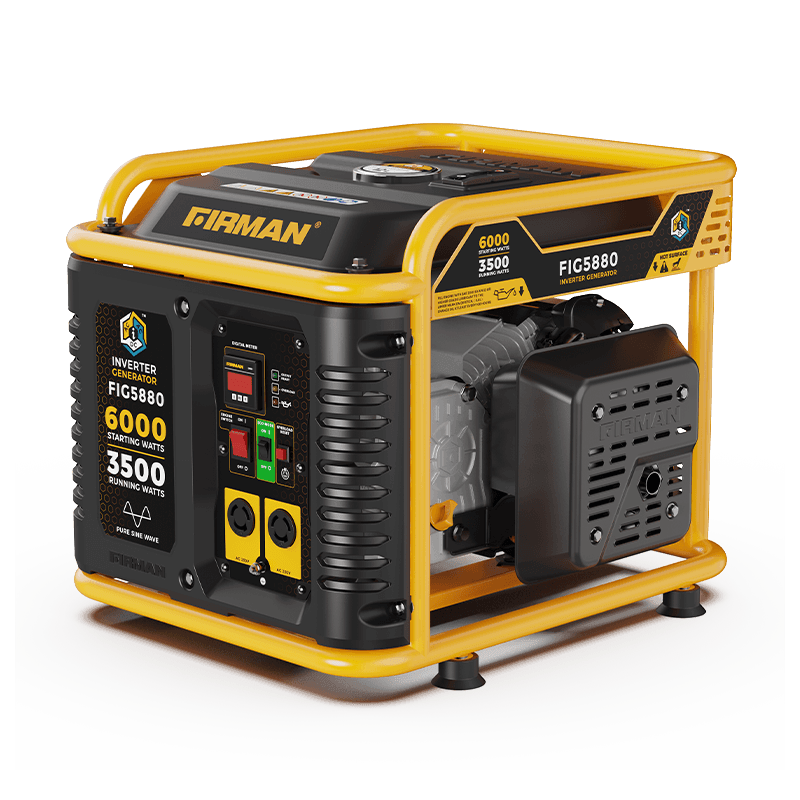
Firman’s FIG5880 shows why conventional generators still have a role alongside inverter technology. This petrol generator provides 6.0 kW of starting power and 3.5 kW of running power. It has a 12 L fuel tank and an alternator using 100% copper-enamelled wire. It supports recoil, and electric starting, with an ECO mode. It gives pure sine wave, THD <3, with which you can plug-in the electronic divices safely. For logistics planning, the FIG has a gross weight of 29 kg and a packing size of 440 × 540 × 440 mm.
Firman lists a noise level of 64 dB at 7 meters and an approximate 18.5-hour runtime on one tank at 50% load. Its weight makes it more suited to applications where output capacity and wheeled mobility are more important than the lightweight form factor of smaller inverter generators.
Evaluate the Supplier, Not Just the Generator
For business buyers, selection should extend beyond one model’s specification sheet. Established power equipment manufacturers can provide broader product portfolios, technical documentation, service resources, and application support. Buyers should verify warranty terms, spare-parts availability, manuals, certifications, and after-sales arrangements before procurement.
This matters when generators are purchased for fleets, rental operations, construction projects, hospitality facilities, or emergency preparedness. A technically suitable generator can still become a poor commercial choice if maintenance support or parts availability is inadequate.
Use Portable Generators Safely
Portable petrol generators produce carbon monoxide and must never be operated inside homes, garages, sheds, basements, or other enclosed or partially enclosed spaces. The U.S. Consumer Product Safety Commission advises operating portable generators outdoors and at least 20 feet from the home, with exhaust directed away from buildings.
Buyers should follow manufacturer instructions, use appropriate outdoor-rated electrical equipment, and maintain working carbon monoxide alarms in the home. Safety features and applicable certification should also be reviewed, particularly for residential backup applications.
Making the Final Choice
The best generator depends on the application rather than the word “inverter” on a product page. For sensitive electronics, lower noise, compact transport, and load-responsive operation, an inverter generator can be a strong fit. For heavier loads where higher continuous output and open-frame construction matter, a conventional petrol generator may be more suitable.
Firman’s FIG5880 shows why buyers should compare specifications with actual requirements. Its 3.5 kW running output, 6.0 kW starting output, 12 L tank, multiple starting methods, and 64 dB rating at 7 meters provide concrete parameters for evaluation. Matching output, portability, runtime, noise, support, and safety to the application leads to a more defensible equipment decision.
