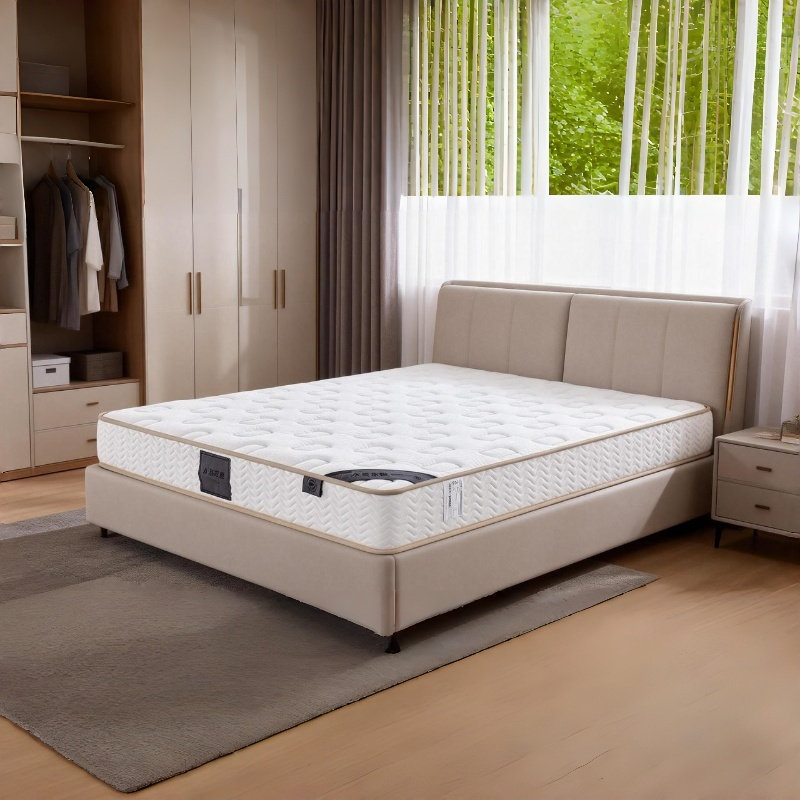
A mattress sample can be comfortable and still be a poor basis for a wholesale program. The supplier must repeat that sample across sizes, order cycles, and possibly several retail channels. Selecting a spring mattress supplier therefore involves product range, written specifications, sampling, and the practical ability to deliver consistent batches. Price makes sense only after those elements are clear.
Wholesale buyers also need to decide which parts of a range must stay common. A retailer may want two comfort levels on the same support platform; a hotel group may need one construction in several dimensions. The supplier’s proposed range should show how those variations will be identified and reproduced.
Map the Spring Constructions on Offer
“Spring mattress” covers different systems and edge treatments. Pocket-spring arrangements can vary in wire gauge, zoning, or perimeter reinforcement. Comfort layers may use memory foam, shaped foam, dense support foam, or other materials. Two products with similar outward profiles can therefore serve different price or comfort positions. The buyer needs a specification for each candidate, not just a catalogue category.
Suisin Furniture lists several pocket-spring examples rather than one uniform construction. MT-209 uses independent pocket springs described with 1.8 mm wire around the mattress and 2.0 mm at the edge, along with memory foam, wave foam, rigid cotton, and high-density foam. For MT-210, the listed materials include flame-retardant cotton and high-density foam; support comes from 2.0 mm smart pocket springs. These differences give a wholesaler options, but each must be matched to a defined customer group.
A size or fabric change needs a clear explanation of its effect on the finished mattress. A revised cover can affect appearance and handling, while a different thickness can affect carton size and bed compatibility. Wholesale planning works best when the buyer records the intended model, available sizes, materials, target feel, and packaging as one complete offering.
Use Samples to Fix the Order Specification
A sample is a reference for feel, finish, and construction. Its value emerges in the intended setting: showroom display, online fulfillment, or hospitality installation. The sample stage is also the right time to compare labels and product descriptions with what is physically present. A revision made after approval should lead to a new documented version. The finished version also has to match its carton and retail description.
Suisin Furniture offers OEM and ODM options, samples, bulk production, packaging, and export support. For a wholesale buyer, those services matter when the chosen sample must become a repeatable order. The phrase China spring mattress factory may help locate a producer, but selection rests on whether the approved construction can be described precisely and delivered at the required scale.
Material and spring details need practical verification. If an edge uses a different wire gauge, the buyer should know where that gauge applies. If a comfort layer has a particular foam type or density, it should appear in the order record. Those details reduce ambiguity among the sample department, production floor, and purchasing team.
Check the Supply Program Beyond the Bed
Bulk purchasing adds questions that a single sample cannot answer. Minimum order arrangements, production timing, packing forms, shipping dimensions, and change notices define the supply program. A carton that suits container loading may be less appropriate for store display, so the channel has to be stated during quotation.
Quality discussion should focus on repeatability. Agreed checks might cover finished dimensions, appearance, layer placement, spring and edge structure, and packing. Buyers can ask how exceptions are documented and later orders tied to the approved specification. A spring mattress supplier should make those controls intelligible before volume increases.
Cost comparisons are strongest when quotations describe the same size, construction, cover, packaging, and delivery terms. Otherwise, a lower unit price may simply represent a different product or a different share of the logistics work. Samples and specifications give each quote a common basis.
Wholesale buyers can make trial quantities useful by assigning each candidate to a planned sales position. Staff can record customer reactions to firmness, edge feel, and height, then compare those reactions with the sample’s written construction. The findings may justify a different comfort layer or a narrower range before a bulk order is placed. A trial is most informative when its evaluation criteria are set in advance.
The commercial record should identify who approves any change after the first run. A supplier may suggest a substitute fabric or packing material because of availability, but the buyer needs to know whether that affects appearance, feel, or freight dimensions. Written change control protects the retailer’s listing and gives the producer a clear standard. This is especially useful when orders repeat months apart.
The route from factory to sales floor matters. Labels, carton dimensions, and handling instructions need approval with the sample.
A buyer using the search term “China spring mattress factory” still needs evidence that an entire wholesale range can remain stable. Buyers can narrow candidates by construction choice, verify samples, settle customization and packaging, then confirm the records that govern each reorder. A dependable wholesale relationship reproduces the selected mattress when the next shipment is due.
