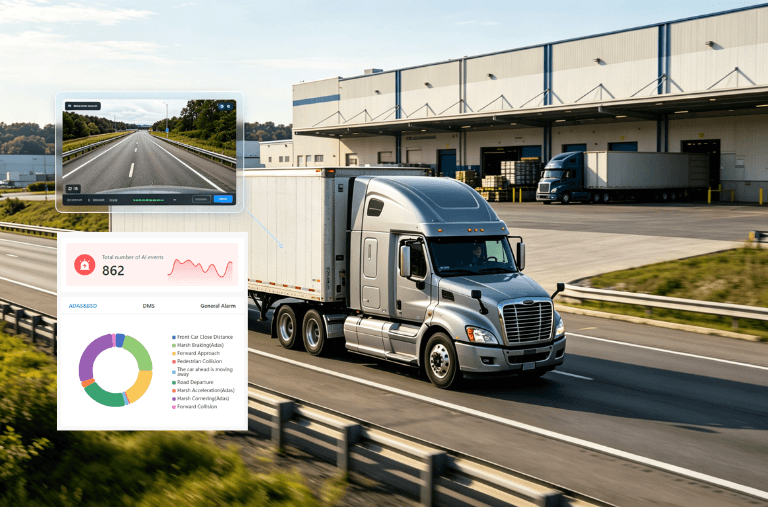
Video telematics connects road footage with vehicle location, driving events, and network communication. An AI dashcam with GPS tracking records video while linking each clip with time and position data. This allows fleet managers to review what happened, where it happened, and when it happened without depending only on driver reports or basic GPS records.
How Video and GPS Data Work Together
The process starts inside the vehicle. The camera records the road or cabin, depending on its configuration. At the same time, the GPS module collects location information. The system connects video with route position, speed, direction, and event time, which gives managers more context when reviewing a trip.
Sensors can also help identify changes in vehicle movement. Collisions, sudden impacts, or unusual vibration may trigger an event record. The related footage can then be marked for later review instead of remaining inside a long continuous video file.
This connection between footage and location data is important after an incident. Fleet staff can check where the vehicle was operating, review the video, and compare the event with route information. This makes accident investigation and internal review more structured.
Why Connectivity Matters
Local recording alone has limitations for commercial fleets. Managers may need event information before a vehicle returns to a depot. Mobile communication allows alerts and selected video clips to move from the vehicle to a remote management platform.
The EH25 is a 4G dashcam designed for connected fleet use. It continuously records video, detects collisions or vibrations, and uploads related alerts and footage to a fleet management platform. It can be used in delivery vans, logistics vehicles, and other commercial fleet applications that require remote visibility.
In this type of deployment, fleet safety dashcams work as connected data terminals rather than simple recording cameras. They collect video, location information, and event records, then send selected data to the platform. Managers can use this information to review incidents and understand what was happening around a vehicle.
How AI Supports Event Review
AI helps reduce the amount of footage that fleet staff need to inspect manually. Instead of watching complete journeys, managers can focus on events that have already been identified by the device or software. The exact functions depend on the hardware configuration and the platform being used.
This becomes important as fleet size increases. A company operating dozens or hundreds of vehicles may generate large amounts of video every day. Event-based review gives staff a more practical way to check collisions, unusual movement, or other configured situations.
When comparing fleet safety dashcams, buyers should therefore look beyond image quality. They should review how events are detected, how quickly alerts are sent, how footage is stored, and how clips are connected with GPS records. These details affect daily fleet management.
Platform Integration Shapes Daily Use
Once information leaves the vehicle, the fleet management platform becomes the main working interface. It may display vehicle location, route records, event time, alerts, and video clips. Managers can use these records to compare what happened on the road with what appears in fleet data.
System integrators and fleet solution providers also need to consider compatibility. Many customers already operate established telematics platforms, so API access and third-party integration can influence deployment planning and long-term system management.
This is where BSJ Technology fits into the wider telematics structure. They develop AI video telematics devices, Fleet IoT products, GPS tracking equipment, and related fleet management solutions for B2B applications. Their ecosystem also supports integration with third-party platforms such as Wialon and GpsGate.
Hardware should therefore be viewed as one part of a wider connected system. The camera, mobile network, management platform, and external software need to exchange useful data. Poor compatibility can add extra work for operators even when the camera itself records clearly.
What Fleet Buyers Should Evaluate
The first step is to define the operating environment. Logistics fleets may focus on route visibility and delivery incidents. Mining and engineering fleets may need equipment that can handle more demanding working conditions. Public transport or school bus operators may place more attention on incident evidence and remote video review.
Alert logic is another practical point. Too many low-value alerts can create unnecessary review work. Too few records may leave managers without enough information when an incident occurs. Buyers should check whether event settings can be adjusted to match fleet policies and operational priorities.
For fleet safety dashcams, installation, connectivity, platform access, technical support, and customization also deserve attention. Distributors may care about OEM and ODM options, while system integrators may focus more on software openness, API access, and deployment support.
BSJ Technology has more than 400 R&D personnel and provides hardware engineering, customization, OEM and ODM cooperation, and global technical support. They also focus on quality control, controlled delivery schedules, and expansion of their AI product portfolio. These capabilities are relevant when partners need to deploy similar systems across different vehicle groups.
From Road Footage to Usable Fleet Information
The working process follows a clear sequence. The camera records video, GPS adds location context, sensors detect vehicle events, 4G transfers selected data, and the management platform organizes the information for remote review.
For fleet operators, this structure can make incident investigation and route review more efficient. For distributors and system integrators, it also provides a clearer framework for matching devices with software and customer requirements. A well-planned AI dashcam with GPS tracking system turns isolated video footage into information that can support routine fleet supervision and event analysis.
