Traditional battery projects can require several subsystems to be specified, delivered, connected, and commissioned as separate packages. Every additional interface between battery equipment, power conversion, thermal control, fire protection, and site wiring creates another point that has to be coordinated during engineering and construction. An all-in-one energy storage solution moves more of that integration into a factory-prefabricated unit.
Its main advantage is not that every project becomes simple, but that fewer critical interfaces are left to be assembled and reconciled on site.
Integration Changes Where Project Complexity Is Managed
An all in one energy storage system combines major storage functions within one coordinated product architecture. Battery clusters, power-conversion equipment, controls, protection, and thermal management can be designed around a common set of operating assumptions before the unit arrives at the project location.
That moves a portion of integration work from field construction into product engineering and factory preparation, where configuration can be repeated more consistently. It also makes the boundary between factory responsibility and site responsibility clearer, which can simplify engineering coordination before installation begins.
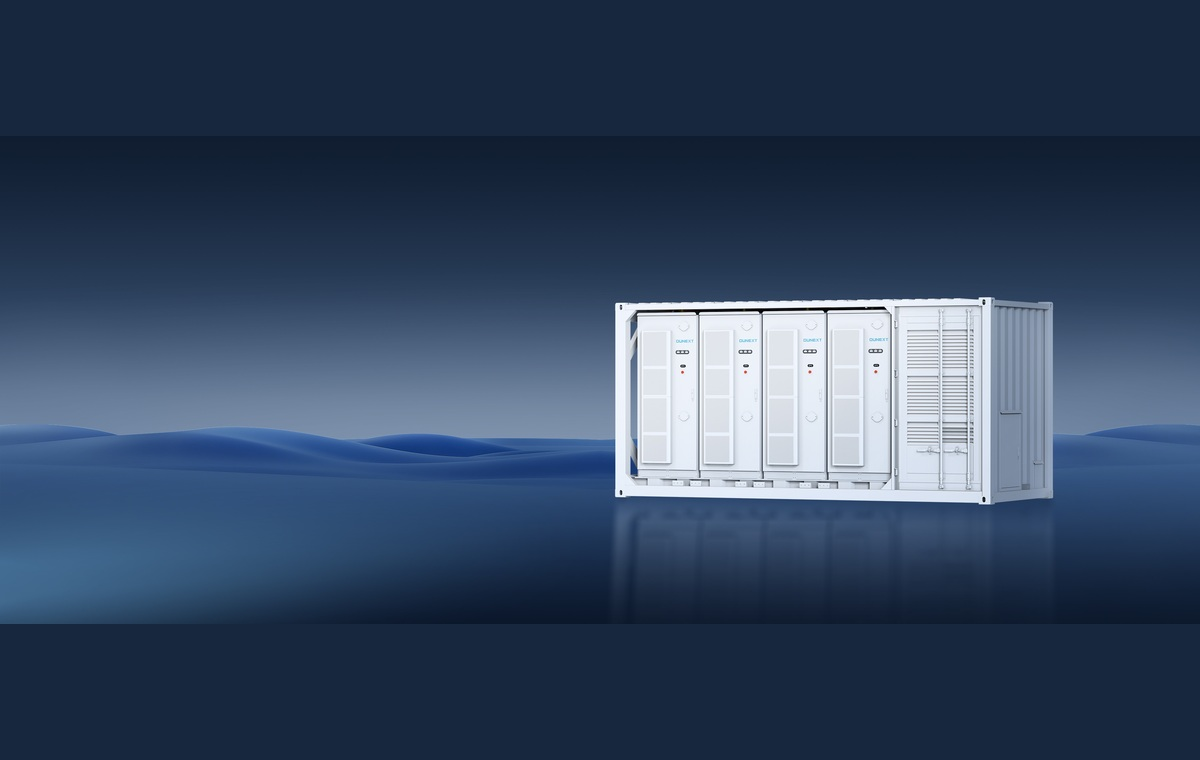
In PowerMount 2MWh, Dunext applies this idea to a containerized C&I BESS. The all-in-one energy storage solution provides 400 V output, active safety, modular expansion, and simplified O&M. It can connect directly at 400 V without an external transformer.
Removing that external conversion step from suitable projects reduces one piece of site equipment and narrows the number of electrical interfaces that have to be coordinated during deployment.
Independent Battery Clusters Localize Control
A large container does not have to treat every battery cluster as one inseparable block. Independent cluster management can limit how far a local condition influences the rest of the system. In an all in one energy storage system, separate monitoring and protection at cluster level also creates clearer boundaries for temperature control, fire response, and operational diagnosis.
The architecture can therefore simplify service while preserving a high degree of internal control.
PowerMount 2MWh manages each battery cluster independently and gives each cluster its own temperature-control and fire-suppression system. Real-time monitoring and algorithms are used to detect abnormal conditions and adjust operation before thermal problems spread. Within the all-in-one energy storage solution, this design means integration does not require every internal function to be centralized into one undifferentiated control point.
The system remains integrated at product level while retaining local protection around individual battery clusters. That separation is useful because a large container can still preserve fault-management boundaries internally instead of depending on one common response for every cluster.
Modularity Keeps One Product Relevant to Different Projects
Factory integration is most useful when it does not force every site into exactly the same capacity and power rating. Modular design can preserve the deployment benefits of a standardized container while allowing the configuration to change with project size.
An all in one energy storage system therefore needs a defined range of battery and PCS options rather than a single fixed combination that suits only one load profile.
Dunext specifies modular battery configurations from 1 to 2 MWh and PCS power from 500 kW to 1 MW for PowerMount 2MWh. Available battery capacities include 1,505.28, 2,007.04, and 2,250.75 kWh, with rated output options of 480, 720, and 960 kW.
These combinations show how an all-in-one energy storage solution can remain factory-integrated while giving project designers several energy-to-power ratios to match against site requirements. A project can therefore select a configuration around its load profile without giving up the installation advantages of the integrated format.
Factory Prefabrication Changes Site Work
Deployment time depends heavily on how much assembly and verification still has to occur after delivery. A prefabricated container arrives with major internal relationships already established, so site activity can concentrate on placement, external connection, testing, and commissioning.
The all in one energy storage system does not eliminate civil works or grid requirements, but it can reduce the amount of equipment-level integration performed under construction-site conditions. That distinction is important because simplification comes from shifting work into a controlled prefabrication stage, not from removing the technical requirements of the project.
Installation Metrics Show the Deployment Effect
PowerMount 2MWh is factory-prefabricated, and Dunext states that on-site installation and commissioning can be completed in about four hours. The company also states a 67% reduction in installation time and a 23% reduction in footprint. IP54 protection is specified for the product.
In the all-in-one energy storage solution, these figures describe the deployment consequence of integrating more functions before shipment: less installation work and a more compact site arrangement, provided the project fits the product’s electrical and physical envelope.
Deployment simplification comes from moving specific integration tasks upstream into product engineering and factory preparation. Integration is resolved earlier, battery clusters retain local control, modular options preserve sizing flexibility, and prefabrication reduces the work remaining at the site.
PowerMount 2MWh illustrates that logic through direct 400 V connection, independent cluster management, multiple capacity and power configurations, and factory-prefabricated installation. The result is a deployment model in which more of the system is engineered as a product before construction begins.
For projects that fit the electrical and physical envelope, that redistribution of work can make installation more predictable without hiding the engineering complexity that still has to be resolved.
