Warehouse lighting affects far more than visibility. It influences worker safety, picking accuracy, energy consumption, maintenance schedules, and the ability to adapt a facility to changing storage requirements. For procurement managers, facility operators, and lighting contractors, selecting industrial LED lights for warehouse applications requires a closer look at technical specifications rather than at wattage or price alone. Evaluating these factors systematically helps businesses choose a reliable lighting solution that suits their building and operational needs.
- Luminous Output and Illuminance Requirements
Lumens measure the total visible light emitted by a luminaire, while lux measures the amount of light reaching a surface. These figures serve different purposes: a fixture with high lumen output does not automatically provide sufficient illumination at floor level or on warehouse shelving.
Buyers should assess the lux requirements of individual work areas, including storage aisles, loading bays, packing stations, inspection zones, and pedestrian routes. Ceiling height, rack configuration, and fixture spacing all influence the result. A professional lighting design should use these details to calculate appropriate fixture quantities and positions rather than relying on a general watts-per-square-meter estimate.
- Energy Efficiency and Actual Power Consumption
Luminaire efficacy, expressed in lumens per watt (lm/W), indicates how efficiently a fixture converts electrical power into visible light. Comparing efficacy alongside light output helps procurement teams identify options that can meet illumination targets without unnecessary energy consumption.
The total connected load also matters. Buyers should account for fixture wattage, the number of luminaires, operating hours, and electricity tariffs when estimating annual energy costs. For retrofit projects, comparing the existing installation with the proposed system provides a clearer basis for evaluating potential savings. Dimming controls, occupancy sensors, and daylight-responsive systems may further reduce consumption where operating conditions support their use.
- Color Temperature and Color Rendering
Correlated color temperature (CCT), measured in kelvins (K), describes whether light appears warm, neutral, or cool. Warehouses often favor neutral or cool white light for operational visibility, but the appropriate choice depends on the tasks performed, the working environment, and employee comfort.
Color rendering index (CRI) indicates how accurately a light source renders colors compared with a reference source. A higher CRI can be valuable for quality inspection, label identification, and handling color-coded inventory. Procurement teams should compare CCT and CRI against the facility’s actual requirements instead of assuming that one setting suits every department.
- Beam Angle, Mounting Height, and Light Distribution
Beam angle determines how light spreads from a luminaire, affecting coverage, overlap, and illumination uniformity. Narrower distributions can help direct light into tall storage aisles, while wider distributions may suit open floor areas. The right selection depends on mounting height, aisle width, shelf geometry, and the position of work surfaces.
Buyers should review photometric data and lighting layout simulations before approving a design. Excessive spacing can create dark areas, while poorly selected optics may produce glare or waste light above the intended working zone. For industrial LED lights for warehouse projects, uniformity is especially important because sudden changes in brightness can make movement and visual tasks more difficult.
- Lifespan, Thermal Management, and Maintenance
LED performance depends partly on heat management and operating conditions. High ambient temperatures, poor heat dissipation, and unsuitable installation environments can affect service life and reliability. Buyers should therefore examine the manufacturer’s rated operating temperature, thermal design, and published lifetime data.
Pay attention to the distinction between LED lifetime and complete luminaire lifetime. Lifetime ratings such as L70 describe the period over which light output is expected to decline to 70% of its initial level under specified conditions; they do not guarantee that every component will operate without failure for that duration.
Warranty coverage, driver quality, replacement-part availability, and maintenance access also deserve consideration. A fixture that costs less initially may prove more expensive if repairs require specialist equipment, extensive downtime, or difficult access at height.
- Ingress Protection, Impact Resistance, and Electrical Safety
Warehouse environments vary considerably. Dust, moisture, cleaning procedures, temperature fluctuations, and potential impacts from equipment can affect luminaire suitability. The required protection level should match the conditions in each installation zone.
The IP rating describes protection against solid objects and water, while the IK rating classifies resistance to mechanical impacts. Neither rating should be selected without considering actual site exposure. Buyers should also verify electrical ratings, applicable product certifications, installation requirements, and compatibility with the facility’s supply system.
For food handling, cold storage, or other specialized operations, additional requirements may apply. Procurement specifications should clearly identify these conditions so suppliers can recommend suitable products and provide supporting documentation.
- Installation Flexibility and LED Light Trunking
Warehouse operations rarely remain static. New racking, revised picking routes, and changes in storage density can make a fixed lighting arrangement less practical over time. A modular lighting infrastructure can simplify future adjustments and reduce the need for extensive rewiring when the facility’s layout changes.
An LED light trunking system integrates luminaires with a continuous trunking infrastructure, helping organize lighting connections across large spaces. Depending on the system design, compatible luminaires may be repositioned along the trunking to accommodate changing requirements. Buyers should verify electrical compatibility, available mounting positions, circuit capacity, and the procedures required for safe modifications.
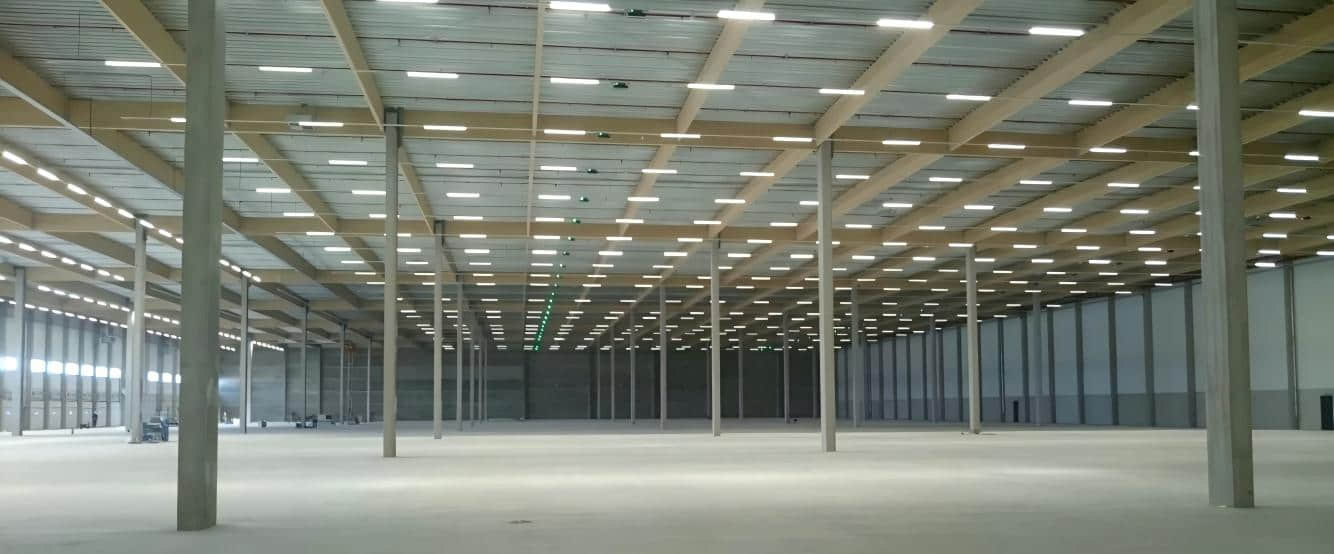
This approach is particularly relevant to large distribution centers and manufacturing facilities where installation efficiency and long-term adaptability matter. TRIECO specializes in LED lighting retrofits, providing integrated solutions for industrial facilities and other commercial environments. Its trunking light system was installed across a 20,000 m² warehouse in the Netherlands, where a regular grid creates an organized ceiling layout and supports consistent illumination across extensive working and circulation areas. The modular architecture also offers flexibility as storage and operational layouts evolve.
- Controls, Compatibility, and Total Cost of Ownership
Lighting controls can improve operational flexibility, but compatibility should be confirmed before procurement. Buyers considering occupancy sensors, daylight harvesting, or centralized management should check dimming protocols, control interfaces, driver compatibility, and commissioning requirements.
The final purchasing decision should also consider total cost of ownership (TCO), not just the initial equipment price. A useful comparison includes fixtures, installation labor, electrical modifications, controls, energy use, maintenance, and eventual replacement costs over the expected service period.
For projects involving LED light trunking, the evaluation should include the trunking infrastructure and installation requirements alongside the luminaires themselves. A complete cost assessment helps businesses compare competing proposals on equivalent assumptions and identify where an integrated retrofit may offer practical advantages.
Making a Better Warehouse Lighting Investment
Choosing industrial LED lights for warehouse applications requires a balanced assessment of illumination, efficacy, light distribution, durability, safety, controls, and future adaptability. No single specification determines whether a system will perform well; the interaction between the equipment and the warehouse layout is equally important.
A documented lighting design, verified product data, and a realistic lifecycle cost comparison give procurement teams a stronger basis for decision-making. For facilities with extensive continuous lighting runs, an LED light trunking solution may also simplify installation planning and accommodate future layout changes. By assessing these factors before purchasing, businesses can select a lighting system that supports operational requirements while keeping long-term costs and maintenance demands under control.
