Nanofiltration is a pressure-driven membrane process used when water treatment needs selective separation. It is often chosen when dissolved salts, hardness, organic matter, or microorganisms need to be reduced.
For buyers comparing membrane systems, nanofiltration NF differs from reverse osmosis in its separation range. It can retain many unwanted substances while allowing part of the dissolved mineral content to pass. This balance affects water quality, energy use, and system design.
What Nanofiltration Actually Does
Nanofiltration membranes use very small pores and charge-based separation. Water passes through the membrane under pressure, while dissolved substances are rejected according to molecular size, ionic charge, and membrane characteristics.
The process is especially effective for larger dissolved ions and many organic compounds. Divalent ions such as calcium and magnesium are often removed more strongly than monovalent ions such as sodium and chloride. That is why nanofiltration is frequently used for hardness reduction.
The membrane does not treat every contaminant at the same rate. Feed-water chemistry, pressure, temperature, pH, and membrane condition can change performance. Water testing is important before selecting a membrane element.
For industrial users, this selective behavior is useful when full demineralization is not required. The target may be lower hardness, reduced organic load, improved process water, or better protection for downstream equipment.
Which Substances Can Be Reduced
One common reason to use nanofiltration is the removal of natural organic substances. These compounds can affect color, odor, downstream treatment, and finished-water stability. Membrane separation can reduce a significant part of this organic load.
Nanofiltration can also remove many pesticides and larger organic contaminants. The actual rejection rate depends on molecular structure and membrane type. System designers should review feed-water analysis instead of relying only on a general product description.
Microorganisms are another important target. Bacteria and viruses are much larger than the membrane separation range, so suitable nanofiltration systems can provide a strong physical barrier. System integrity, installation quality, cleaning, and operating conditions still matter in practice.
Hardness removal is another common application. Calcium and magnesium can contribute to scaling in boilers, heat exchangers, and process equipment. Reducing these ions can support stable operation and lower the treatment load on later stages.
Where Removal Has Practical Limits
Nanofiltration is not the same as total desalination. Some monovalent salts may pass through more easily, so the final salt level can remain higher than with reverse osmosis. This can be acceptable when the goal is selective purification rather than very low conductivity.
The type and concentration of dissolved material also influence membrane behavior. A membrane selected for hardness reduction may not perform the same way when sodium chloride is the main concern. Buyers should match the membrane to the water source and required permeate quality.
Pretreatment also affects results. Suspended solids, oxidants, scaling compounds, and biological growth can reduce membrane performance. Filtration, chemical conditioning, cleaning plans, and monitoring should be considered together with membrane price, energy use, replacement intervals, and delivery time.
How Membrane Design Supports Industrial Use
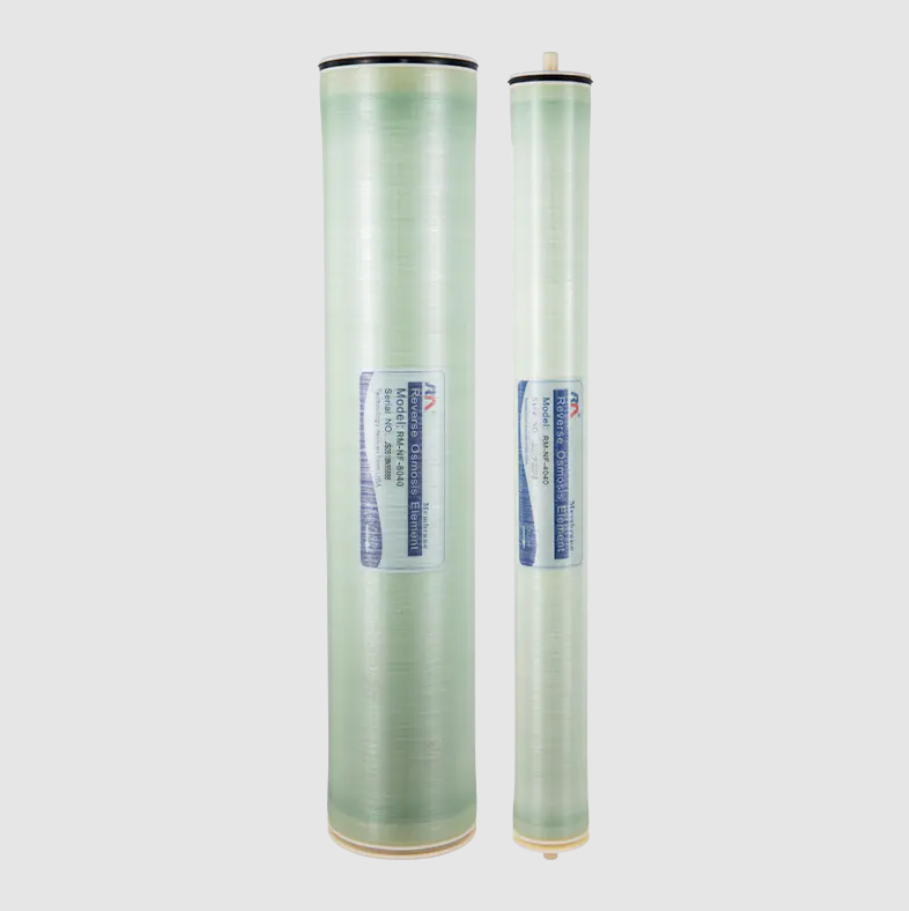
For larger projects, membrane selection depends on rejection performance and operating efficiency. The NF Series of Nano-filtration Membranes supplied by Runmo is designed for large industrial and municipal water treatment systems and is intended to provide high permeate water with strong desalination performance.
The membrane series is used to remove pesticides, viruses, bacteria, and natural organic substances. It also provides a medium level of total hardness removal. Its membrane surface is designed with higher strength and oxidation resistance for demanding water treatment conditions.
The series uses an ultra-low-pressure operating mode. Lower operating pressure can reduce system energy demand when feed-water conditions and treatment targets are suitable. Operating pressure should therefore be reviewed during technical comparison.
Its application range includes pure water preparation, boiler recharge water, food processing, and pharmaceutical manufacturing. These uses have different water-quality targets, so selection should be based on actual feed-water data and required output quality.
How Buyers Should Evaluate a Nanofiltration Project
A practical evaluation starts with water analysis. Buyers should review hardness, conductivity, organic content, suspended solids, microorganisms, pH, and other relevant contaminants. These figures define the treatment problem clearly.
Next, the engineering team can compare rejection rates, operating pressure, permeate flow, recovery rate, cleaning requirements, and compatibility with existing equipment. For nanofiltration NF, this matters because selective salt removal is a key difference from reverse osmosis.
Project buyers also need to consider supply factors. Price matters, but quality consistency and delivery time can affect installation schedules and replacement planning. Water treatment engineering companies often need these three points to align before an order can move forward.
Runmo serves water treatment companies, engineering firms, solution providers, and business users with membrane products for industrial water applications. They focus on practical product quality, project suitability, and supply support, helping buyers compare membrane options against operating needs.
A Clearer Way to Choose the Right Treatment
Nanofiltration is useful when a project needs selective removal rather than complete salt rejection. It can reduce hardness, natural organic matter, many pesticides, bacteria, and viruses, while some smaller dissolved salts may remain in treated water.
The right decision depends on feed water, target water quality, operating cost, membrane condition, and delivery requirements. Buyers who compare these factors together can build a more realistic treatment plan. Contact the supplier with a recent water analysis and project target to discuss a suitable membrane configuration.
