Modern business networks need more than basic connectivity. As enterprises add IP cameras, access points, industrial controllers, servers, and other connected devices, network administrators need greater visibility and control over traffic. An ethernet managed switch provides that additional layer of control through configurable features, which can improve network organization, availability, performance, and security. For businesses operating critical or growing networks, these capabilities can make managed switching a practical infrastructure investment.
What Makes an Ethernet Managed Switch Different?
The main difference between managed and unmanaged switching is control. An unmanaged switch generally forwards traffic automatically with little configuration, while a managed switch allows network professionals to configure and monitor network behavior. This makes managed switches more appropriate for larger or more critical environments where administrators need to optimize performance and troubleshoot problems.
Managed switching can also support more flexible network topologies. Depending on the model, organizations may use features such as VLANs, spanning tree protocols, link aggregation, traffic prioritization, and remote monitoring. These capabilities allow network teams to build infrastructure around operational requirements instead of relying only on basic plug-and-play connectivity.
Network Segmentation and Traffic Control
As the number of connected devices increases, keeping every endpoint within the same logical network can make administration more difficult. VLAN capabilities available on many managed switches allow administrators to divide a physical network into logical segments. Different device groups can therefore be separated according to business function, helping organizations structure traffic more effectively.
Traffic prioritization is another important capability. Quality of Service, or QoS, can prioritize traffic according to its requirements. This can be particularly useful when latency-sensitive applications such as voice or video share network resources with less time-critical traffic. Proper prioritization helps network administrators allocate available bandwidth according to operational needs.
Improved Network Resilience with STP and RSTP
Network availability is a major consideration for businesses that depend on continuous connectivity. Redundant links can provide alternative paths, but they can also create Layer 2 loops if they are not controlled properly. Spanning Tree Protocol addresses this issue by selectively placing links into standby states to prevent loops while maintaining an alternative path.
Rapid Spanning Tree Protocol, or RSTP, improves convergence compared with traditional STP, allowing the network to react more quickly to topology changes. These protocols are therefore valuable when network architecture requires redundancy without allowing multiple active paths to create forwarding loops.
Better Visibility and Network Administration
A major advantage of an ethernet managed switch is the ability to monitor and configure network behavior rather than simply connect devices. Depending on the switch platform, administrators may have access to management interfaces, traffic information, diagnostic functions, and network management protocols.
SNMP, for example, allows a management station to communicate with network devices and obtain information from them. This can support centralized monitoring and help IT teams identify network conditions without checking each switch individually. Management capabilities can also simplify troubleshooting and configuration across business networks.
Choosing Hardware for Demanding Environments
Network functionality is only one part of switch selection. Physical operating conditions, port configuration, uplink requirements, and reliability should also be considered. Commercial facilities, industrial sites, transportation systems, and other demanding environments may require equipment that can tolerate wider temperature ranges and electromagnetic interference.
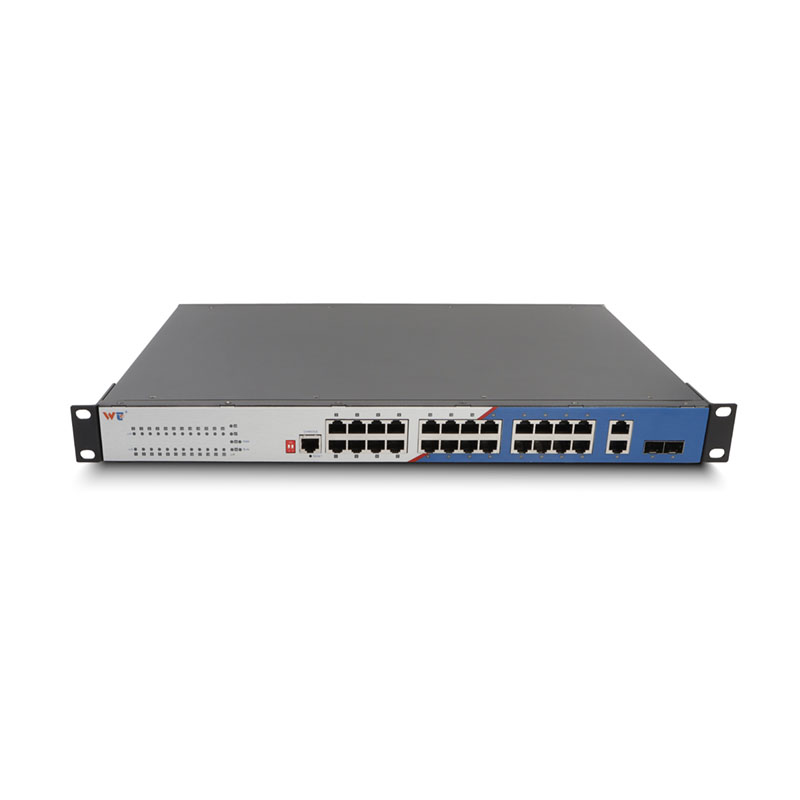
The Wintop CM6328-2GF26GT is designed for such demanding network communication applications. This Layer 2 managed switch provides 26 Gigabit Ethernet 10/100/1000BASE-T RJ45 ports and two 1G SFP ports. It has an IP30 protection rating, operates from -20°C to 75°C, and incorporates high EMI/EMS protection. Wintop also states that every unit undergoes a 100% aging test before delivery.
Ring Protection for Higher Availability
For networks where communication continuity matters, ring-based architectures can provide an additional path between network devices. However, a ring must incorporate appropriate protection mechanisms to prevent Layer 2 loops during normal operation.
The CM6328-2GF26GT supports ring configuration with a stated switching time of less than 20 ms, along with STP/RSTP ring network protection. These functions can help network designers build redundant Layer 2 connections while maintaining controlled traffic paths. For applications where downtime can interrupt production or other critical processes, this type of resilience can be an important consideration.
Matching Managed Switching to Business Requirements
A managed switch should be selected according to the actual requirements of the network rather than simply the number of available ports. Businesses should consider the required copper and fiber interfaces, network topology, environmental conditions, redundancy strategy, management requirements, and future expansion.
For example, a facility that needs many Gigabit copper connections but also requires fiber uplinks may benefit from a switch combining both interface types. Similarly, environments that require redundant paths should examine whether the selected equipment supports appropriate loop-prevention and recovery mechanisms. This approach helps organizations avoid paying for unnecessary capabilities while ensuring that critical requirements are covered.
A Practical Network Infrastructure Choice from Wintop
Wintop is a network equipment supplier and national high-tech enterprise specializing in the R&D, production, and sales of optical modules and switches. Its CM6328-2GF26GT combines 26 Gigabit RJ45 ports with two 1G SFP ports in a Layer 2 managed platform, while its -20°C to 75°C operating range, IP30 protection, EMI/EMS protection, aging testing, and ring protection features address demanding deployment conditions.
For businesses planning or upgrading a managed Ethernet network, Wintop can provide network equipment suited to connectivity, redundancy, and industrial communication requirements. Contact Wintop to discuss your network equipment requirements and identify a suitable switching solution for your application.
