Accuracy and linearity answer different questions, and separating the two is essential when evaluating precision current measurement. Accuracy describes how closely a measured value approaches the actual current, while linearity shows how consistently the sensor follows the ideal input-output relationship across its measurement range.
Fluxgate Current Sensors are often selected for applications where small deviations matter, but a meaningful comparison also requires attention to offset, temperature drift, noise, bandwidth, and long-term stability. Hangzhi develops high-precision current and voltage transducers around multi-point zero-flux control, an approach suited to demanding AC/DC measurement environments.
Understanding Accuracy Beyond a Single Percentage
A sensor’s accuracy figure should always be read alongside its test conditions. Temperature, current level, supply voltage, frequency, and measurement duration can all influence the reported result. A specification such as 0.02% may appear straightforward, yet it does not necessarily describe identical performance at every point across the operating range.
Linearity focuses on the shape of the measurement curve. If the actual output gradually departs from the ideal relationship as current changes, the resulting linearity error can become visible in calibration systems, power analyzers, and precision control loops. Fluxgate measurement works by detecting magnetic imbalance and generating a compensating signal, allowing the sensing system to operate around a near-zero magnetic flux condition. This closed-loop principle is associated with low offset and strong linearity.
Offset presents another source of error, particularly around low current. A small absolute offset can represent a much larger percentage error when the measured signal approaches zero. Temperature can compound the problem by shifting both offset and gain. Consequently, specifications for precision applications should be examined across the expected temperature range rather than relying solely on room-temperature figures.
How Linearity Changes Across the Measurement Range in Fluxgate Current Sensors
A broad current range is useful only when meaningful accuracy is available throughout that range. A sensor rated for hundreds or thousands of amperes may spend much of its operating life at a fraction of nominal current. Checking performance at low, medium, and high current levels can reveal behavior that a single nominal specification cannot show.
Hangzhi’s AIT Series offers a 1–10,000 A measurement range with 10 ppm accuracy, while the IIT Series extends to 30 kA with 0.02% accuracy. The AIT Series achieves 2 ppm linearity and bandwidth options of 800 kHz or 500 kHz. These figures demonstrate why linearity and bandwidth should be reviewed together rather than treating accuracy as an isolated number.
Frequency can also alter measurement behavior. A current waveform containing switching ripple or rapid transients may interact differently with the sensing system than a slowly varying DC signal. Hangzhi’s fluxgate technology is designed for AC, DC, pulsed, and complex waveforms, with bandwidth options reaching 800 kHz depending on configuration.
Temperature, Noise, and Long-Term Stability
Temperature stability deserves close attention in industrial measurement because the performance of Fluxgate Current Sensors rarely remains at a fixed ambient condition. Thermal changes can affect magnetic materials, electronic components, gain, and offset. A specification expressed in ppm/K or a similar temperature coefficient provides a more useful indication of how measurement behavior may shift during operation.
Noise has a different effect from linearity. A linear sensor can still produce an unstable reading if electrical or magnetic noise is large relative to the signal being measured. External magnetic fields, conductor geometry, switching devices, grounding arrangements, and nearby power cables can all contribute to interference. Closed-loop fluxgate designs commonly incorporate measures intended to reduce sensitivity to such disturbances.
Long-term stability connects these factors over time. Calibration equipment, medical systems, battery test platforms, and precision power analyzers may require consistent readings over extended operating periods. A sensor with low initial error but substantial drift can become less useful than one with slightly lower headline accuracy and stronger stability under real operating conditions.
Reading Specifications in the Context of a Real Application
A practical evaluation should begin with the actual current waveform, followed by the required measurement range, temperature envelope, isolation level, response speed, output interface, and mechanical arrangement. Galvanic isolation is especially valuable in high-voltage systems because it separates the measurement electronics from the primary conductor. Fluxgate architectures can provide isolated AC/DC measurement while retaining high precision.
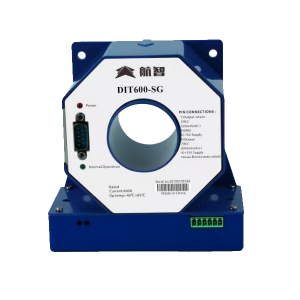
Digital communication can further influence how a precision transducer fits into a control or monitoring system. Hangzhi’s DIT Series, for example, covers 60–2000 A, specifies 0.02% accuracy, and provides RS232/RS485 digital signal output. The configuration illustrates a broader design consideration: sensor accuracy must be considered alongside how measurement data is transferred, processed, and incorporated into the wider system.
The About Hangzhi page offers additional background on the company’s measurement technology and multi-point zero-flux approach. Such technical context can help readers distinguish between a sensor’s numerical specifications and the underlying architecture responsible for its measurement behavior. A proper comparison should still rely on the complete datasheet, application conditions, and independent validation rather than a single performance figure.
Conclusion
Accuracy tells how close a result is to the expected value; linearity explains how consistently that relationship is maintained as current changes. Neither figure tells the whole story without offset, temperature behavior, noise, bandwidth, isolation, and long-term stability. Fluxgate Current Sensors are particularly relevant to measurement systems where these variables must remain tightly controlled across AC and DC operation.
Hangzhi applies multi-point zero-flux technology to high-precision current and voltage measurement, while the About Hangzhi page provides additional information about its technical approach. A project requiring detailed application guidance can contact us to discuss the relevant current range, waveform, environmental conditions, and interface requirements.
