Semiconductor packaging relies on precise adhesive placement to protect delicate interconnections, reinforce chips, and maintain package reliability. Selecting a suitable liquid dispensing valve requires more than checking nominal accuracy: adhesive rheology, package dimensions, gap geometry, and process repeatability all influence the final result.
Even minor variations in deposit volume can affect coverage or create unwanted overflow. Axxonauto operates in precision fluid dispensing, a field where equipment performance must be evaluated against the specific demands of electronic manufacturing.
How to Understand Flow Behavior Within Semiconductor Packages?
Adhesives perform several functions during packaging, including filling gaps beneath dies, bonding package edges, and reinforcing vulnerable structures. Each application creates different flow conditions. Capillary underfill relies on fluid flow through narrow gaps beneath the die, while no-flow underfill is applied before solder ball attachment and cured during the reflow process. Surface bonding, by comparison, requires controlled adhesive placement along a defined path.
Fluid viscosity is only one part of this behavior. Surface tension, wetting characteristics, temperature, and substrate condition also influence how material spreads. A fluid that moves easily across an exposed surface may struggle to penetrate a narrow gap, particularly if the geometry restricts flow or the surface does not support effective wetting.
Air entrapment presents an additional challenge. Uneven flow fronts, contaminated surfaces, or unsuitable dispensing conditions may leave voids within the adhesive layer. Material preparation and substrate cleanliness should be assessed alongside dispensing parameters, with trials designed to reproduce the actual package structure.
How to Define Deposit Geometry Before Setting Parameters?
A dispensing recipe should begin with the required deposit rather than an arbitrary machine setting. Engineers need to establish the target volume, placement tolerance, acceptable overflow, and coverage requirements for each application. These specifications provide measurable criteria for evaluating the process.
Nozzle dimensions influence both flow resistance and deposit shape. A narrow outlet can support fine placement, but thick materials may require greater force to pass through it. Excessive pressure can cause spreading or splashing, whereas insufficient delivery may produce irregular deposits or incomplete coverage.
Package height and component spacing also affect access. Closely positioned structures can restrict the dispensing head’s movement, making nozzle orientation and positioning accuracy particularly important. Simulating the intended motion path and testing representative package layouts can reveal accessibility problems before production begins.
| Parameter | Why it matters | Control method |
| Deposit volume | Coverage and overflow risk | Valve timing and pressure calibration |
| Placement tolerance | Avoid contact with neighboring structures | Motion accuracy and vision alignment |
How to Match Valve Technology to Material Requirements?
The dispensing mechanism must accommodate the adhesive’s physical properties and the desired application pattern. Needle-based methods can suit accessible bonding paths and continuous beads. Jetting, by contrast, deposits discrete droplets without requiring direct nozzle contact, which can be useful around delicate structures or densely arranged components.
High-viscosity fluids present a particular engineering challenge because their movement requires sufficient actuation force and carefully controlled delivery conditions. Temperature, valve response, nozzle design, and operating frequency interact to determine whether each deposit forms consistently. Adjusting one parameter without considering the others may improve one characteristic while introducing another defect.
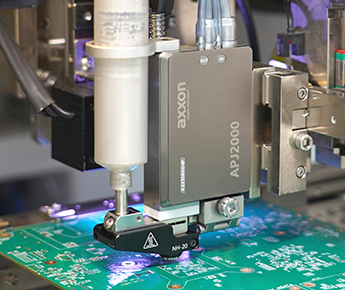
The APJ2000 Piezo Jetting Valve is designed for a broad range of fluid viscosities, specified up to 200,000 cps. Its piezoelectric mechanism and enhanced jetting force support applications involving medium- and high-viscosity materials. Suitability for a semiconductor process still depends on the selected adhesive, target dimensions, required droplet size, and results from application-specific testing.
Within this evaluation, glue dispensing systems should be compared using actual material samples and representative components. Useful measures include deposit diameter, volume variation, placement deviation, cycle time, and the frequency of defects. These results offer a more meaningful comparison than a single equipment specification.
How to Verify Process Stability Across Production Runs?
A successful setup during initial testing does not necessarily remain stable throughout extended manufacturing. Changes in material batches, nozzle condition, temperature, and mechanical calibration can alter dispensing behavior over time. Routine verification helps detect these shifts before they affect a substantial number of packages.
Inspection methods should reflect the adhesive’s function. Optical inspection can identify misplaced deposits, irregular shapes, and visible overflow, while dimensional measurement can compare deposit size against specified tolerances. Applications involving hidden gaps or internal voids may require additional inspection techniques suited to the package structure.
Process records make troubleshooting more systematic. Material lot, operating temperature, valve settings, maintenance activity, and inspection findings can be reviewed together to identify possible causes of variation. A documented maintenance schedule also helps manage residue buildup and component wear, both of which may influence long-term consistency.
Conclusion
Reliable semiconductor packaging depends on the relationship between fluid properties, deposit geometry, dispensing mechanics, and process verification. A suitable liquid dispensing valve must perform consistently with the actual adhesive and package design, not merely satisfy a nominal specification.
Through representative trials and measurable acceptance criteria, manufacturers can determine which dispensing approach fits their requirements. Axxonauto provides a relevant reference for evaluating precision fluid application technologies in demanding electronic manufacturing environments.
FAQs
Why Is Viscosity Important in Semiconductor Glue Dispensing?
Viscosity affects flow resistance, droplet formation, and the ability of adhesive to enter narrow gaps. Temperature and surface characteristics also influence the result, so testing should reproduce the intended application conditions.
Can High-Viscosity Adhesives Be Jet Dispensed?
Certain jetting mechanisms are designed to handle thicker materials, provided their actuation force and operating parameters suit the fluid. Material compatibility and deposit consistency should be confirmed through practical trials.
How Can Manufacturers Reduce Voids in Underfill Applications?
Appropriate material conditioning, clean surfaces, controlled temperature, and validated dispensing parameters can help reduce the risk of trapped air. Inspection should verify that the adhesive reaches the required areas beneath the component.
Which Factors Matter When Comparing Glue Dispensing Equipment?
Key factors include viscosity compatibility, deposit repeatability, placement accuracy, cycle time, maintenance requirements, and inspection capability. Representative production trials provide a reliable basis for comparing performance.
